Key Takeaways
Understanding what affects app development time helps Vancouver business owners set realistic expectations and avoid the scope, integration, and complexity pitfalls that derail custom builds.
- Software complexity is the single largest driver of build time. Multiple user roles, custom logic, and real time data processing compound each other and can push enterprise builds to a year or more.
- Unclear scope is the most common cause of projects going over schedule. Defining user types, core features, and integrations before development begins protects both your timeline and your budget.
- Every third party or internal system integration adds a dependency your team does not fully control. Sandbox testing, rate limits, and production behaviour differences all add time that initial estimates frequently undercount.
- Features like dashboards, reporting tools, and role based permissions consistently take longer than expected. Identifying and scoping these early prevents quiet timeline creep during the build.
- A structured discovery phase and phased delivery process are protective investments. They catch quality issues early, reduce costly rework, and keep you informed at every stage without requiring you to manage technical complexity yourself.
If you have ever asked a development firm how long a project will take and walked away more confused than when you started, you are not alone. Understanding what affects app development time is one of the most consistently misunderstood parts of commissioning a custom build, and the gap between expectations and reality is where most projects run into trouble. For business owners in Vancouver who are outgrowing their current systems and ready to build something purpose-built for how they actually work, getting clear on the real drivers of timeline is the first step toward a project that delivers on time and on budget. Proper app development timeline planning starts well before the development team does.
Most delays are predictable. They do not come from mysterious technical problems that only developers can see. They come from factors that business owners can understand, anticipate, and address before a single line of code is written. This article walks you through the most significant of those factors so you can enter your next planning conversation with realistic expectations and the right questions already in hand.
Table of Contents
Why Business Owners Misjudge App Development Time
The most common reason business owners underestimate timelines is that they compare their project to something that looks similar on the surface. Two apps can share the same general purpose and still differ by months in build time depending on what is happening underneath. A food ordering app with basic menu listings and a fixed payment method is a fundamentally different engineering problem from one that supports multiple vendor dashboards, real-time inventory sync, and loyalty point calculations. The visible interface rarely reveals the complexity behind it.
There is also a tendency to think of development as the only phase that consumes time. In reality, discovery, design, integration testing, QA, and deployment each carry their own weight. According to a GoodFirms survey on mobile app development time factors, security implementation, platform evaluation, and feature scope are primary determinants of total development time, with enterprise-level projects placing especially high demands on security as a core activity. When any of these phases are underestimated or skipped, the timeline does not shrink. The pressure simply shifts to a later, more expensive stage. The biggest delays, more often than not, trace back to decisions made on the business side before the developers ever start.
How Software Complexity Shapes Your Build Time
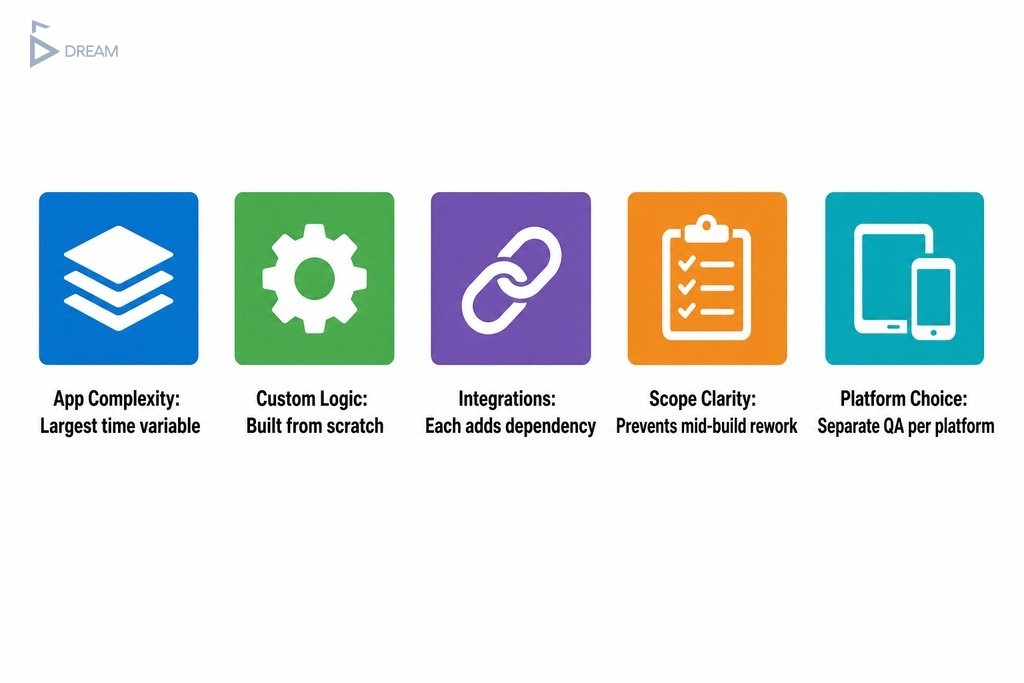
Software complexity is the single largest variable in how long a custom app takes to build. This includes the number of user roles supported, the depth of your data relationships, the logic rules that govern how information moves through the system, and the number of screens a user can navigate. Each of these dimensions compounds the others. A system with three user roles that each see different data, trigger different workflows, and receive different notifications is not three times more complex than a single-role system. It is exponentially more involved to design, build, and test correctly.
Apps with AI integration, real-time data processing, and complex algorithmic logic can take a year or more to develop, according to Rivers Agency’s research on app development timeframes. Moderately complex apps with custom features, database integration, and API connections typically require several months. These are not small differences. They represent the gap between what a business owner pictures when they describe their idea and what the development team sees when they map the logic required to make it real.
| Complexity Level | Typical Characteristics | Relative Build Time | Key Timeline Drivers |
|---|---|---|---|
| Simple | Standard functionality, single user role, minimal integrations | Shorter | Feature count, platform choice |
| Moderate | Custom features, database integration, API connections, multiple roles | Several months | Custom logic, integration testing, QA cycles |
| Enterprise / High | AI integration, real-time data processing, complex algorithmic logic, advanced security | A year or more | Security implementation, data architecture, platform evaluation |
Custom Logic vs. Off-the-Shelf Behaviour
Many app features follow standard patterns that development teams have solved dozens of times before. User registration, profile editing, and basic search all fall into this category. They can be built efficiently because the underlying logic is well understood and often reusable. Custom logic is a different matter. When your business has a pricing model, approval chain, or data calculation that is unique to how you operate, the development team cannot import a library or adapt a template. They have to engineer the behaviour from scratch, test it against every edge case, and document it so it can be maintained and extended later. That process takes time, and it is where two seemingly similar apps begin to look very different on a build schedule.
Features That Extend App Timelines Without Warning
Certain feature categories consistently take longer to build than clients expect. Dashboards are a prime example. A well-built dashboard is not a simple display of numbers. It requires thoughtful data aggregation, permission-aware filtering, refresh logic, and visual design that remains readable across different screen sizes. Notification systems that account for user preferences, time zones, delivery channels, and opt-out rules are substantially more involved than a basic push alert. Role-based permissions add another layer, because every screen and every action in the app has to be evaluated against who is allowed to see or do what.
Reporting features are another area where scope tends to expand quietly. A request for “a few basic reports” often evolves into custom date ranges, export formats, filters by team member or region, and scheduled delivery by email. Each addition is a legitimate business need, but each one extends the timeline. The most effective way to manage these features is to identify them early, define their exact scope before development begins, and separate must-haves from nice-to-haves in the first planning conversation.

The Integration Impact on Timeline Most Teams Overlook
Integrating your new app with existing tools, whether that is a payment processor, an accounting platform, a shipping provider, or an internal database, is one of the most underestimated sources of delay in any custom build. Third-party APIs change, have rate limits, require sandbox testing environments, and occasionally behave differently in production than in testing. Each integration introduces a dependency that your team does not fully control, and that uncertainty has to be accounted for in the schedule.
Internal system integrations carry their own complications. Legacy infrastructure, custom database schemas, and undocumented business logic in existing tools all require careful mapping before a reliable connection can be made. It is worth noting that nearly 70% of users will abandon an app if it takes more than 3 seconds to load, according to Google, which means integration performance is directly tied to whether your users stay. Testing integrations thoroughly is non-negotiable, and that testing takes time that often is not reflected in initial estimates.
| Integration Type | Common Examples | Timeline Impact | Main Complications |
|---|---|---|---|
| Third-party API | Payment processors, shipping providers, CRMs | Medium to high | Rate limits, sandbox vs. production differences, API versioning |
| Accounting / ERP platform | QuickBooks, Xero, SAP | Medium to high | Data mapping, sync frequency, error handling |
| Internal legacy system | Custom databases, older internal tools | High | Undocumented logic, custom schemas, no official API support |
| Standard web services | Email delivery, analytics, maps | Low to medium | Configuration, performance tuning, opt-out compliance |
How Unclear Scope and Weak Discovery Add Weeks to Your Project
Arriving at a development project without a defined scope is one of the most reliable ways to extend your timeline and inflate your budget. When scope has not been established before work begins, the team is forced to conduct discovery mid-project, which interrupts momentum, delays decisions, and requires rework on completed components. Figuring things out late almost always costs more than figuring them out early.
A structured discovery phase is a timeline-saving investment, not an added step. It is where user journeys get mapped, data requirements get documented, and ambiguous business rules get resolved. At Twelfth Dream, discovery is built into the process from the start because every hour spent clarifying scope before development protects many hours of engineering time later. Vancouver business owners who have been through a poorly scoped project once rarely need to be convinced of this twice.
The Design Review Timeline Factor
Design is one of the phases where client involvement is highest, and where delays are most preventable. When feedback arrives late, when multiple stakeholders weigh in at different times, or when a significant design direction changes after development has already begun building against it, the cost compounds quickly. Setting clear review windows, consolidating feedback from all internal stakeholders before submitting it, and resolving direction questions before design moves to development are habits that protect the entire project schedule.

What a Structured Development Process Actually Protects
A phase-by-phase delivery process keeps the client informed at every stage, reduces expensive rework, and creates natural checkpoints where decisions can be made before they become costly to reverse. Twelfth Dream’s adaptive release process is built around this principle. Rather than handing over a finished product after months of silence, the team delivers in stages, inviting client review and feedback at each step. If priorities shift or a business need changes mid-project, the adjustment can be made before it touches every downstream component.
Understanding how agile development works for business apps is worth exploring on its own, because iterative delivery has a meaningful effect on both timelines and outcomes. When testing phases are embedded throughout the build rather than bolted on at the end, quality issues are caught early. Research from Abbacus Technologies suggests that nearly half of users will uninstall an app that crashes or freezes frequently, and 29% will abandon an app immediately if it is not responsive, according to Google. Protecting against those outcomes requires dedicated testing time, and a structured process ensures that time is planned for rather than sacrificed under deadline pressure.
How Vancouver Business Owners Can Estimate Smarter Before Committing to a Custom Build
The most effective thing a business owner can do before requesting a development quote is to define the variables that drive the estimate. Not every detail needs to be resolved, but the broad strokes of scope, integration requirements, and user types should be documented in advance. This saves time in the scoping conversation and tends to produce a more accurate estimate on the first pass.
Before your planning conversation, work through these five preparation areas:
- User types: List every role that will interact with the app and what each role can see, create, edit, or delete.
- Core features: Identify the five to ten features that must exist for the app to function, and separate them from features that would be valuable but are not essential at launch.
- Integrations: Document every external tool, platform, or data source the app will need to connect with, including payment processors, CRMs, and internal databases.
- Edge cases: Think through scenarios that fall outside the normal user flow, such as failed payments, permission conflicts, or data imports from legacy systems.
- Platform: Decide whether you need iOS, Android, web, or a combination, since that decision directly affects design, development, and QA cycles.
Coming into the conversation with this clarity does not require a technical background. It requires knowing your own business well enough to describe how it operates and what the app needs to support. That is exactly the kind of input that Twelfth Dream’s team is built to receive and translate into a realistic, well-scoped plan.
If you are ready to move from a rough idea to a structured plan, Twelfth Dream’s team in Vancouver is ready to help you think it through. Reach out to start a conversation about your project and what a realistic, well-scoped timeline could look like for your business.
Frequently Asked Questions About App Development Time
How long does it typically take to build a custom business app?
Build time depends on complexity. A moderately complex app with custom features and API integrations generally takes several months, while a simpler app with standard functionality can be completed faster. Enterprise-level builds with AI or real-time data processing may take a year or more.
What is the biggest factor that causes app projects to go over schedule?
Unclear or shifting scope is the most common cause. When requirements are not fully defined before development begins, the team must pause to resolve ambiguity mid-build, which interrupts momentum and often triggers costly rework on completed components.
Does the number of integrations really affect how long my app takes to build?
Yes, significantly. Every third-party API or internal system connection introduces a dependency your team does not fully control. Sandbox testing, rate limits, and production behaviour differences all add time that initial estimates frequently undercount.
Why does the discovery phase matter for my project timeline?
Discovery resolves scope, data requirements, and business rules before any code is written. Time invested here prevents far more expensive rework later, making it a protective measure for both your timeline and your budget rather than an optional preliminary step.
How does platform choice affect app development time?
Building for iOS, Android, and web simultaneously requires separate design, development, and QA cycles for each platform. Choosing one platform at launch and expanding later is a common approach for Vancouver businesses looking to reduce initial build time and cost.