Key Takeaways
Choosing your app monetization strategy before development begins protects your budget, shapes your feature set, and positions your product to earn revenue from day one.
- Decide on your revenue model before a single line of code is written. Your chosen model determines which technical features must be built from the start, including payment gateways, access gating, and tier logic. Adding these after development begins typically causes costly rebuilds and delays.
- Subscription models suit specialized professional tools where users engage frequently and ongoing value is clear. Annual plan subscribers retain at a rate of 28% beyond year one compared to only 12% for monthly subscribers, making early annual commitments both a cash flow and a retention strategy.
- Freemium works best when users need to experience your product before committing to pay, but most freemium apps convert only 2% to 5% of active users to paid tiers. For small, specialized markets, this conversion range may not generate enough revenue to sustain the business.
- Match your revenue model to three core market variables: willingness to pay, frequency of use, and platform dynamics. iOS audiences support higher per user pricing while Android and broader markets favour volume dependent models such as freemium or advertising.
- Treat your initial revenue model as a validated hypothesis with clear success criteria defined before launch. Monitor conversion rates, churn after the first billing cycle, and user pricing feedback so you can make iterative adjustments rather than expensive structural changes after launch.
One of the most consequential decisions a founder makes has nothing to do with code, design, or infrastructure. It happens weeks or months before any of that, in the planning phase, when you decide how your app will actually make money. Getting your app monetization strategy right at this stage shapes everything from which features get built first to how much development will realistically cost and how long it takes to recover that investment.
If you have deep expertise in your field and a genuine insight into a market gap, the temptation is to move quickly toward building. But committing to development without a clear revenue model is one of the most expensive mistakes early-stage founders make. The decisions you make now, before a single line of code is written, will echo through every phase of your product’s life.
Table of Contents
Why Your Revenue Model Should Come Before Your First Line of Code
Your revenue model is not a detail you can bolt on after the product is built. It is a structural decision that determines what your product needs to do, who it needs to serve, and what technical infrastructure it must support from day one.
A subscription-based app requires payment gateway integration, access gating, and tier management logic that a free, ad-supported app simply does not. Choose your model after development begins, and you are often looking at expensive rebuilds and delayed timelines. The revenue model also directly shapes feature prioritization. If your product earns through marketplace fees, it needs trust infrastructure, transaction flows, and potentially escrow mechanics. If it earns through advertising, you need volume, making onboarding and retention the primary technical concerns.
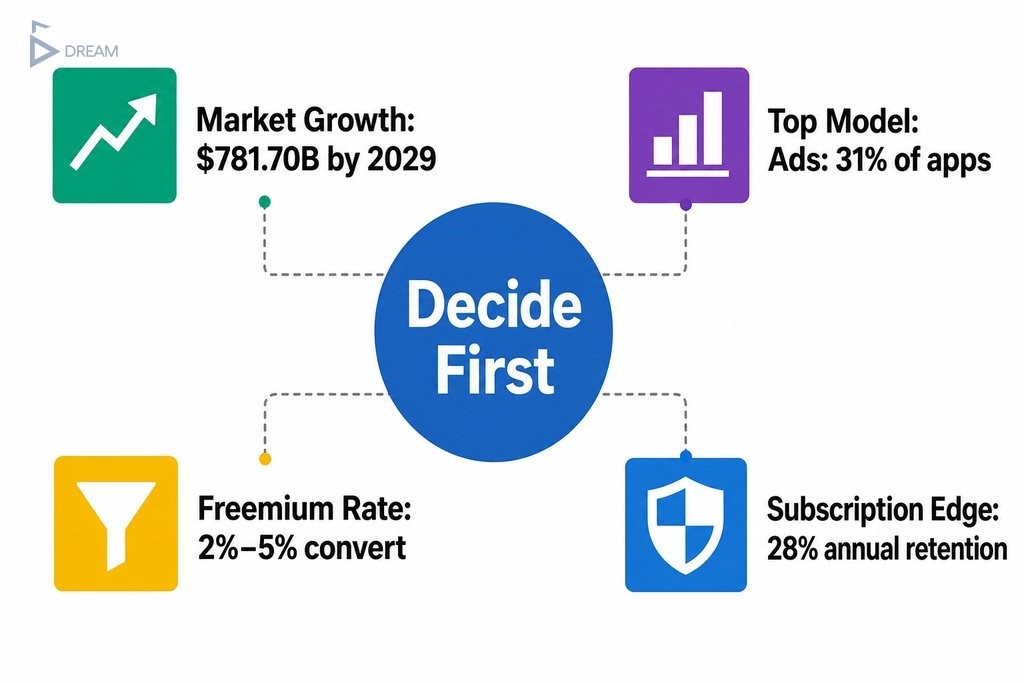
Building without this clarity means your development team is essentially guessing, and in software, guessing is costly. According to Statista, the total app monetization market is expected to grow at a compound annual growth rate of 7.48% through to 2029, reaching a projected market volume of $781.70 billion. The opportunity is real, but capturing it requires deliberate planning, not reactive decision-making.
The Most Common App Monetization Models and What Each One Demands
Before you can choose a revenue model, you need to understand what each one demands of your product and your team. The core options available to most founders are subscriptions, freemium, one-time purchases, in-app purchases, marketplace fees, and advertising.
Each has a different conversion logic, a different technical footprint, and a different relationship with your target user. In-app advertising is the most prevalent monetization method, with 31% of apps globally relying on it, according to data cited by Droidsonroids from Statista 2024. That prevalence signals accessibility, but also that the market is crowded and volume-dependent.
Hybrid models combining two or more revenue streams, such as subscriptions alongside in-app advertising, are increasingly adopted by high-performing apps to reach different user segments more effectively. For founders building a specialized professional tool, blending a core subscription with optional premium add-ons can protect base revenue while giving power users a reason to spend more. The key is making this decision before your architecture is locked in.
Subscription Model for Apps
Best for: Professional tools, niche platforms, and products where continued use delivers ongoing value.
The recurring billing structure creates predictable revenue, which supports financial planning and future investment conversations. However, it places genuine pressure on the product to keep delivering. If a user does not see continued value, cancellation is one tap away.
How you structure the billing cycle matters more than many founders realize. Research cited by Electroiq shows that subscription models retain 28% of annual plan customers beyond their first year, compared to only 12% of monthly plan customers. Encouraging annual commitments early is not just a cash flow move; it is a retention strategy. For apps in specialized or professional niches, where switching costs are higher and trust takes longer to build, the subscription model often aligns well with user behaviour.
Freemium App Strategy
Best for: Markets where users need to experience the product before committing to pay.
A freemium strategy works by offering a genuinely useful free tier that drives adoption, then converting a percentage of engaged users to paid features. Most freemium apps convert somewhere between 2% and 5% of active users to paid tiers, which means your user acquisition strategy must be ambitious enough to make those numbers work at scale. If your target market is small and specialized, freemium may not generate enough volume to sustain the business.
The central risk is cannibalization. A free tier that is too generous means users never feel the need to upgrade; one that is too restricted means they churn before experiencing real value. For founders entering markets where users already pay for competing solutions, freemium can be an effective acquisition wedge. For entirely new categories, it is a harder case to make.
| Factor | Subscription Model | Freemium Model |
|---|---|---|
| Best fit | Professional tools, niche platforms, ongoing-value products | Markets where users need to try before they buy |
| Revenue predictability | High — recurring billing creates a stable baseline | Variable — depends on conversion volume |
| Conversion benchmark | 28% of annual plan users retained beyond year one | Typically 2% to 5% of active users convert to paid |
| User acquisition pressure | Moderate — pricing filters for committed users | High — large user base needed to make conversions viable |
| Key risk | Churn if ongoing value is not consistently delivered | Cannibalization if free tier is too generous or too restrictive |
| Technical requirements | Payment gateway, access gating, tier management logic | Tier access logic, upgrade prompts, conversion tracking |
| Fit for small, specialized markets | Strong — higher per-user revenue offsets a smaller audience | Challenging — low conversion rates may not sustain the business |
How to Match a Revenue Model to Your Specific Market Gap
Choosing between these models is a market research exercise, not a preference decision. Three variables are worth working through carefully.
Willingness to pay: How urgent is your user’s problem, and how much do they currently spend solving it? A specialized tool that replaces a manual, time-intensive workflow has a stronger case for a premium subscription than a lifestyle app competing against dozens of free alternatives.
Frequency of use: Apps used daily, such as productivity tools and communication platforms, can sustain subscription pricing because value is delivered repeatedly. Apps used occasionally may convert better through one-time purchases or pay-per-use models.
Platform dynamics: iOS users consistently generate higher average revenue per user than Android users, while Android leads in total install volume. If your audience skews toward iOS, your per-user revenue assumptions can be more aggressive. If you are targeting a broader Android market, volume and conversion mechanics matter more.
| Market Variable | Signal | Better-Fit Model |
|---|---|---|
| Willingness to pay | Users already spend on solving this problem; high urgency | Subscription or one-time purchase |
| Willingness to pay | Many free alternatives exist; low urgency | Freemium or advertising |
| Frequency of use | Daily or near-daily engagement | Subscription |
| Frequency of use | Occasional or situational use | One-time purchase or pay-per-use |
| Platform dynamics | Audience skews iOS | Higher per-user pricing viable; subscription or premium |
| Platform dynamics | Audience skews Android or broad market | Volume-dependent models; freemium or advertising |
| Market size | Small, specialized niche | Subscription; avoid volume-dependent models |
| Market size | Large, broad consumer market | Freemium, advertising, or marketplace fees |

App Monetization Planning in Vancouver — What to Decide Before Launch
App monetization planning is an input to your product roadmap, not a checklist item completed after it is finalized. The technical decisions that flow from your revenue model include payment gateway selection and integration, user authentication and tier-based access logic, pricing page design and trial period mechanics, and the data infrastructure needed to track and attribute revenue accurately.
Each of these has direct implications for your development timeline and budget. Deciding early also protects you from one of the most common and costly scenarios in early-stage product development: building a product that users like but that was never architected to charge for. The broader context of app launch and growth planning makes it clear that revenue architecture is not an afterthought; it is a foundation. Consumer spending on apps reached approximately $155.8 billion in 2025, with in-app advertising generating approximately $390 billion, according to App Verticals citing aggregated industry data. The market rewards apps built around clear commercial intent, not ones that discovered it after launch. For founders based in Vancouver and the broader BC tech ecosystem, this planning discipline is especially relevant, as local development costs and time-to-market pressures make budget overruns particularly difficult to absorb.
Realistic Limitations and When to Revisit Your Approach
No revenue model is guaranteed. Treat your chosen model as a validated hypothesis, the best fit based on available evidence, with room to adjust based on what users actually do.
Early signals that warrant a closer look include low conversion rates from free to paid, high churn after the first billing cycle, consistent user feedback that pricing feels misaligned, and an inability to acquire users at a cost that makes unit economics work. Revisiting does not mean abandoning. Sometimes the model is right but the pricing needs adjustment; sometimes the free tier needs restructuring to create better upgrade motivation.
Define your success criteria before launch so you can distinguish between a model that needs iteration and one that simply needs more time. Understanding how to choose the right app business model is itself an evolving question, as markets shift, user behaviour changes, and competitive pricing pressure rarely stays static after you launch.

How a Structured Development Partner Supports Revenue-Ready Builds
When Twelfth Dream works with founders in the pre-build phase, one of the first conversations is about revenue architecture, because it determines scope. A client with a specialized professional platform came to the team with a strong domain concept but had not yet decided whether to charge through subscriptions, one-time licensing, or marketplace fees. Rather than beginning design immediately, the discovery phase was used to map out how each model would affect the feature set, the technical infrastructure, and the realistic timeline to first revenue.
By building only the features essential to validating the chosen revenue model first, the team avoided building capabilities the business did not yet need and could not yet afford. This approach reflects Twelfth Dream’s client-centric focus and adaptive release process, meaning technical decisions are tied to business outcomes from day one. The result is a product that is ready to earn from its first public release, not one that earns after months of retrofitting. For non-technical founders in Vancouver and across the Lower Mainland, having a structured partner who connects these decisions is a practical necessity that protects both the budget and the timeline.
Questions Vancouver Founders Should Answer Before Finalising Their App Revenue Strategy
Before locking in your approach, work through the following questions honestly. They are not technical questions; they are business questions that happen to have technical consequences. Understanding common app monetization mistakes is easier when you have asked the hard questions before you are committed to a build.
Every founder should address these before development begins:
- Do you have evidence that your target users will pay for this, and at what price point?
- How frequently will users engage with your app, and does your model match that frequency?
- What are your closest competitors charging, and how does your value proposition justify your pricing relative to theirs?
- Does your chosen model require a large user base to be viable, and do you have a realistic plan to reach that scale?
- Have you mapped out which technical features your revenue model requires, and are they accounted for in your development budget?
These questions will not always have clean answers at the planning stage, and that is perfectly fine. The goal is not perfect certainty; it is to surface the assumptions your monetization strategy depends on so you can test them early rather than discover them expensively after launch. Revenue planning is a business decision first and a technical requirement second, and the founders who treat it that way consistently make better use of their development investment.
If you are at the stage where these questions feel overwhelming, that is exactly where a structured development partner adds the most value. Twelfth Dream works with domain experts and industry visionaries who know their market deeply but need a reliable technical partner to translate that knowledge into a scalable, revenue-ready product. Reach out to start a conversation about your concept, and bring your revenue thinking to the table from day one.
Frequently Asked Questions About App Monetization Strategy
When should I decide on my app’s revenue model?
Decide on your revenue model before development begins. Your chosen model determines which technical features need to be built, including payment gateways, access gating, and tier logic. Adding these after the fact often requires costly rebuilds and delays your timeline to first revenue.
What is the most common app monetization model?
In-app advertising is the most prevalent model, used by approximately 31% of apps globally. That said, prevalence does not mean it is the right fit. Advertising depends on high user volume, which makes it a poor match for small, specialized markets where subscription or one-time purchase models often perform better.
Is freemium a good strategy for a niche professional app?
Freemium can work for niche apps, but the numbers are challenging. Most freemium products convert only 2% to 5% of active users to paid tiers. If your target market is small, that conversion range may not generate enough revenue to sustain the business, and a subscription-first approach is often a stronger fit.
How does my revenue model affect development costs?
Your revenue model directly shapes your technical scope and therefore your budget. A subscription model requires payment gateway integration and tier-based access logic; a marketplace model adds transaction flows and trust infrastructure. Identifying these requirements early prevents unplanned additions that stretch timelines and inflate costs.
Can I change my revenue model after launch?
Yes, but it is typically expensive and disruptive. Switching models after launch often requires significant re-architecture and can confuse or alienate early users. A better approach is to treat your initial model as a validated hypothesis, define clear success criteria before launch, and make iterative pricing adjustments rather than structural model changes.
What should Vancouver-based founders consider specifically?
Local development costs and time-to-market pressures in Vancouver and the broader BC tech ecosystem make budget overruns especially hard to absorb. Finalizing your revenue model before development begins gives your team a defined scope, reduces the risk of mid-build pivots, and positions your product to generate revenue from its first public release.