
Key Takeaways
Agile development builds custom business apps in focused cycles so Vancouver business owners get working software, real visibility, and the flexibility to grow without technical complexity.
- Agile development delivers your app in short focused sprints rather than one large release at the end, so you can review real working software, catch problems early, and keep the project aligned with your actual business needs.
- Sprint cycles create a reliable rhythm of progress and visibility, meaning you are never left waiting months to find out whether the project is on track or heading in the wrong direction.
- Incremental software releases protect your budget at every stage by validating each part of the app before more resources are committed, reducing the risk of costly surprises late in the project.
- A thorough discovery phase before the first sprint is essential: defining must have features, existing system integrations, and how you will measure success sets the entire project up to deliver real value.
- No technical knowledge is required from you as a business owner; your role is to review progress at the end of each sprint, share feedback, and clarify priorities while your development partner handles all the complexity.
At a certain point in every growing business, the tools that once worked start to work against you. Spreadsheets multiply, apps stop talking to each other, and your team loses hours every week to workarounds that should never have been necessary. Understanding how agile development works for business apps is the first step toward building something that actually fits the way your business operates, rather than forcing your team to adapt to software that was never designed with you in mind.
For business owners in Vancouver and across British Columbia who are scaling quickly, a custom app built through an agile process offers something off-the-shelf software simply cannot: the ability to evolve alongside your business, shaped by real feedback at every stage. Whether you’re running a growing operation in Burnaby, managing multiple locations across the Lower Mainland, or building out a national client base from a Vancouver headquarters, this article walks you through what agile development actually looks like from your perspective as an owner, what you can expect at each stage, and how to set a project up for success from day one.
Table of Contents
Why Off-the-Shelf Tools Stop Working as Your Business Grows
Generic software is built for the average business, which means it fits no business perfectly. When your team is small and your processes are simple, that compromise is manageable. But once you add staff, diversify your services, or take on more complex operations, the gaps in off-the-shelf tools become real costs. Your people spend time re-entering data between systems, creating manual workarounds, and navigating software that was never designed for the specific way your team works.
Disconnected systems create invisible inefficiencies that are easy to underestimate until you add them up. When your CRM does not connect to your invoicing tool, or your scheduling app cannot feed into your reporting dashboard, your team ends up doing that integration work manually every single day. A purpose-built application removes that friction by reflecting your actual workflow, not a generic approximation of it. It becomes a true command centre for your operations, one that grows with you rather than placing a ceiling on how far you can scale.
What Agile Development Means for Business Apps
Agile development is a structured, phased approach to building software that prioritizes working results over lengthy documentation. Rather than spending months planning every feature before writing a single line of code, it moves in focused cycles that produce real, usable software at regular intervals. For business owners who want results without being drawn into technical project management, agile is particularly well suited because it keeps you informed without requiring you to manage the details yourself.
According to Digital.ai, 71% of organizations now use agile methods in their software development lifecycle, with improved collaboration and better alignment between software delivery and business goals cited among the top benefits. That broad adoption reflects a widely held recognition that building everything in one long phase and delivering it at the end creates far too much risk for businesses whose needs are always evolving.
How the Agile App Development Process Works
Iterative Development: Building in Meaningful Pieces
Iterative development means your app is built and delivered in meaningful pieces rather than as one large release after a long wait. Each piece is functional on its own, so you can see how it works in practice, gather input from your team, and confirm it actually solves the problem it was designed to address.
This is fundamentally different from traditional waterfall development, where months of work can pass before anyone outside the development team sees anything. Research from the Standish Group Chaos Report has found agile projects to carry a notably higher success rate than waterfall projects, suggesting the iterative model is meaningfully more likely to deliver what was originally intended. For a Vancouver business making a real investment in a custom app, that difference matters.
| Factor | Agile Development | Waterfall Development |
|---|---|---|
| Delivery approach | Working software delivered in regular increments | Full product delivered at the end of the project |
| Visibility for owners | Consistent check-ins at the end of every sprint | Limited visibility until final delivery |
| Ability to adjust priorities | Priorities can shift between sprints | Changes are costly once development is underway |
| Risk of late-stage surprises | Lower — problems caught early | Higher — issues often surface at final review |
| Budget protection | Each stage validated before more resources committed | Full budget committed before results are confirmed |
Sprints: Regular Cycles of Visible Progress
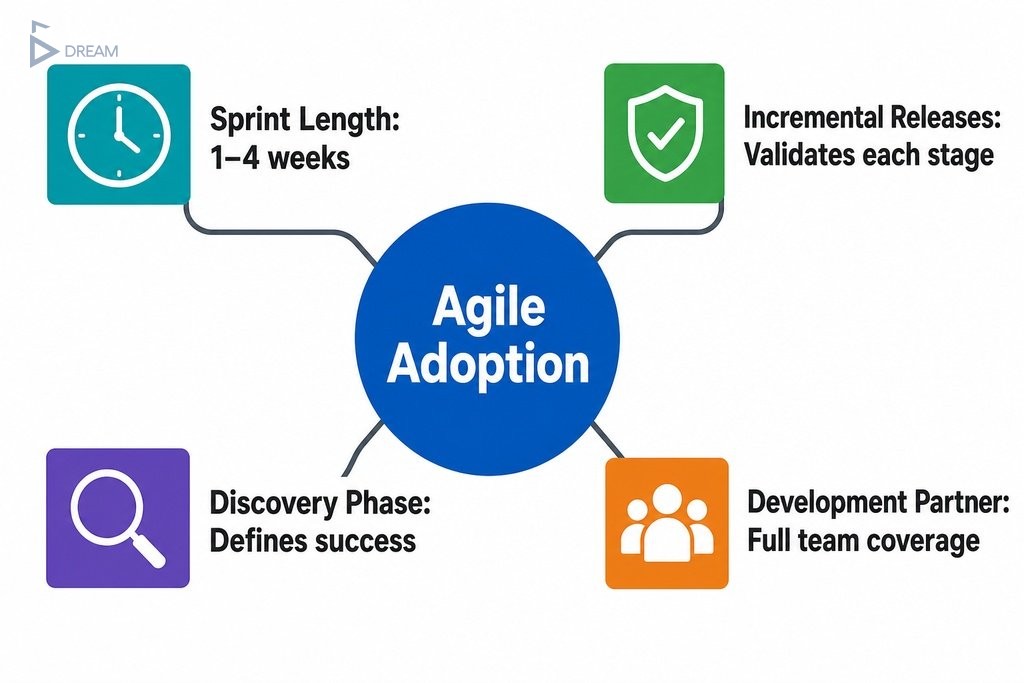
A sprint is a short, focused period of development, typically one to four weeks, during which the team builds and completes a defined set of features. At the end of each sprint, you receive something tangible: a working portion of your app that you can review, test with real users, and provide feedback on before the next cycle begins.
From your perspective as a business owner, sprints create a rhythm of visibility and confidence. You are never left waiting months to find out whether the project is on track. Any misalignment between what was built and what your business actually needs can be caught and corrected early, rather than discovered at the end. This rhythm also makes it much easier to incorporate feedback from your team as they begin using early versions of the app in their day-to-day work.
Release Increments: Protecting Your Investment at Every Stage
Software release increments are one of the most practical protections an agile process offers. Rather than committing your full budget to a complete build and then discovering that certain features missed the mark, incremental releases let you validate each part of the app with real users before more resources are allocated to the next stage.
This is not just a development preference; it is a risk management strategy. Research published by PwC suggests that organizations using agile methodologies tend to be significantly more likely to meet their deadlines and stay within budget compared to those using traditional waterfall approaches. When each piece of work is tested and confirmed before the next begins, the chance of a costly misdirection compounds much more slowly. For a business owner who has watched a software project balloon in scope or drift off course, incremental releases provide a meaningful layer of financial and operational protection.

Staying Informed Without Managing the Details
One of the most common concerns business owners raise about custom software projects is losing sight of where things stand. Agile feedback cycles are specifically designed to address this. Structured check-ins at the end of each sprint replace the guesswork of traditional development, giving you a clear, consistent opportunity to review what has been built, ask questions, and signal any changes to priorities before the team moves forward. You do not need to attend daily stand-ups or technical review sessions. What you need is a reliable cadence of updates that keeps the app aligned with how your business is actually evolving.

What to Confirm Before Your Vancouver App Development Begins
A successful agile app project starts well before the first sprint. The discovery phase is where the most important work happens: clarifying what the app needs to do, which features are essential from day one, how it needs to connect with your existing systems, and what success looks like six months after launch. Skipping or rushing this phase is one of the most common reasons projects drift off track, even when the development itself is well managed.
App development timeline planning is shaped significantly by how clearly these questions are answered at the outset. When goals are vague or must-have features are not distinguished from nice-to-haves, scope tends to expand in ways that affect both budget and delivery timelines. It is also worth noting that what affects app development time extends beyond the feature list: third-party integrations, regulatory requirements, platform choices, and the availability of key stakeholders for reviews all play a role.
Before your project kicks off, be ready to discuss the following clearly:
- The specific workflows or problems the app needs to solve
- Which features are essential at launch versus which can come later
- The existing tools and systems the app needs to integrate with
- How you will measure whether the app is delivering value
| Planning Area | What to Define | Why It Matters |
|---|---|---|
| Workflows and problems | The specific processes the app must support or replace | Keeps the build focused on genuine business needs |
| Feature prioritization | Must-have features at launch vs. nice-to-haves for later | Prevents scope creep and protects budget |
| System integrations | Existing tools the app needs to connect with | Affects timeline, complexity, and technical decisions |
| Success measurement | How you will know the app is delivering value | Aligns the team around outcomes, not just deliverables |
| Stakeholder availability | Who will review progress and provide feedback at each sprint | Ensures timely decisions and avoids delays mid-project |
Building In-House Versus Working With a Development Partner
Hiring a single developer or piecing together a freelance team can seem cost-effective at first. In practice, it often creates coordination challenges that are just as disruptive as the systems problems you were trying to solve. A dedicated external development partner brings a complete, coordinated team, covering business analysis, design, development, quality assurance, and post-launch support, under a single engagement, so nothing falls through the cracks between roles.
Research from Harvard Business Review has found that companies adopting agile methods frequently report positive impacts on both revenue and profitability, though results vary by organization, industry, and how consistently the methodology is applied. Those outcomes tend to come from teams that apply agile practices with discipline and experience across many projects. When evaluating a partner, look for transparent communication at every stage, a delivery process that keeps you informed without overwhelming you with technical detail, and a genuine commitment to supporting the app after it launches. Long-term support is not a luxury for a business app; it is a requirement, because your needs will continue to evolve after go-live.
At Twelfth Dream, we work with business owners in Vancouver and across Canada who are ready to replace the patchwork of disconnected tools with something built specifically for the way they work. Our structured six-step agile app development process takes you from initial discovery through to deployment and ongoing support, with clear visibility at every stage and no technical jargon required on your end. If you are ready to build a digital foundation that grows with your business, we would love to start that conversation with you.
Frequently Asked Questions About Agile Development for Business Apps
What is agile development and how does it differ from traditional software development?
Agile development builds software in short, focused cycles called sprints, delivering working features at regular intervals rather than all at once at the end. Traditional waterfall development completes all planning upfront and delivers the full product at the end, which increases the risk of discovering problems too late to correct them affordably.
How long does a sprint typically last in an agile app project?
A sprint typically lasts one to four weeks, depending on the complexity of the features being built. Shorter sprints give you more frequent checkpoints to review progress and adjust priorities, which is especially useful in the early stages of a custom business app.
Do I need technical knowledge to participate in an agile development process?
No technical knowledge is required. Your role is to review working software at the end of each sprint, provide feedback on whether it meets your business needs, and clarify priorities for the next cycle. A good development partner translates the technical work into plain language throughout.
How does an agile approach protect my budget compared to a fixed-scope project?
Agile releases working software incrementally, so each stage is validated before more resources are committed. Problems are caught early, when they are still straightforward to address, rather than at the end of a long build when changes are far more costly.
Is agile development suitable for small or mid-sized businesses in Vancouver?
Yes. Agile scales to the scope of the project rather than requiring a large, fixed commitment upfront. For growing businesses in Vancouver and across British Columbia, the iterative approach allows the app to evolve alongside changing operational needs without locking you into a rigid, all-or-nothing build.
What should I prepare before starting an agile app development project?
Be ready to describe the workflows the app needs to support, distinguish must-have features from nice-to-haves, identify existing tools that require integration, and define how you will measure success. A thorough discovery phase at the start of the project helps establish all of this before the first sprint begins.