Key Takeaways
Vancouver founders can move from app idea to sustainable growth by combining a focused MVP strategy, a scalable post-launch roadmap, and the right development partner from day one.
- Define your core user and scope your MVP before approaching any development partner. Arriving with a documented vision protects you from scope creep and ensures proposals reflect your actual goals.
- Plan your post-launch app roadmap before a single line of code is written. Structure iterative release cycles around user feedback, retention data, and shifting business priorities to maintain momentum after launch.
- Track meaningful metrics after release. Engagement rates, session length, and day seven and day thirty retention reveal far more about real product health than download counts alone.
- Plan your monetization model during the build phase, not after. Subscriptions, in app purchases, or a freemium structure each shape product architecture, and retrofitting a business model post launch is significantly more costly.
- Choose a development partner who documents milestones, communicates clearly, and has a defined post-launch support process. Ask for references from non-technical founders and watch for vague timelines as an early warning sign.
Having a strong app idea is one thing. Knowing how to bring it to market without losing momentum, overspending, or building the wrong product is something else entirely. For entrepreneurs in Vancouver and across British Columbia, app launch and growth planning is the strategic bridge between a concept that excites you and a product that actually gains traction. Getting this right from the beginning determines not just whether your app ships, but whether it survives its first few months in the hands of real users.
The opportunity is real and growing. According to Grand View Research, the global mobile application market was estimated at USD 252.89 billion in 2023 and is projected to grow at a compound annual growth rate of 14.3% through 2030. That kind of sustained expansion means there has never been a better time to enter the market with a well-planned product. But entering well requires a plan built on clarity, not just enthusiasm.
Table of Contents
Why Most App Ideas Stall Before Launch
Most app ideas stall not because of a lack of motivation, but because there is no structured path from idea to execution. Non-technical founders face a particular challenge: an overwhelming volume of decisions with no clear framework for making them. Which platform do you build on? Which development partner can you trust? Which features actually matter for the first release? Without answers to those questions, decisions pile up and progress stalls.
One of the most common mistakes is approaching vendor selection before the product itself is defined. Founders who begin evaluating developers before clearly articulating what they are building, who it is for, or what success looks like end up with misaligned proposals, wasted time, and contracts that do not reflect the actual vision. The fix is not to avoid outside help — it is to arrive at those conversations with a defined plan already in place.
Start With a Launch Plan, Not a Feature List
The instinct to list every feature you want in your app is understandable, but it is one of the fastest routes to scope creep and blown timelines. A solid launch plan starts somewhere more fundamental: your app’s core purpose, the specific user it serves, and what you need to demonstrate in order to call the first release a success. These three anchors shape every decision that follows.
Defining your target user with precision matters more than most founders expect. The more clearly you can describe who will use your app, what problem they have, and how often they experience it, the better every design and technical decision becomes. This is not a marketing exercise — it is a product discipline that directly reduces development cost and increases the likelihood of early adoption.
What Is an MVP and Why Does It Matter?
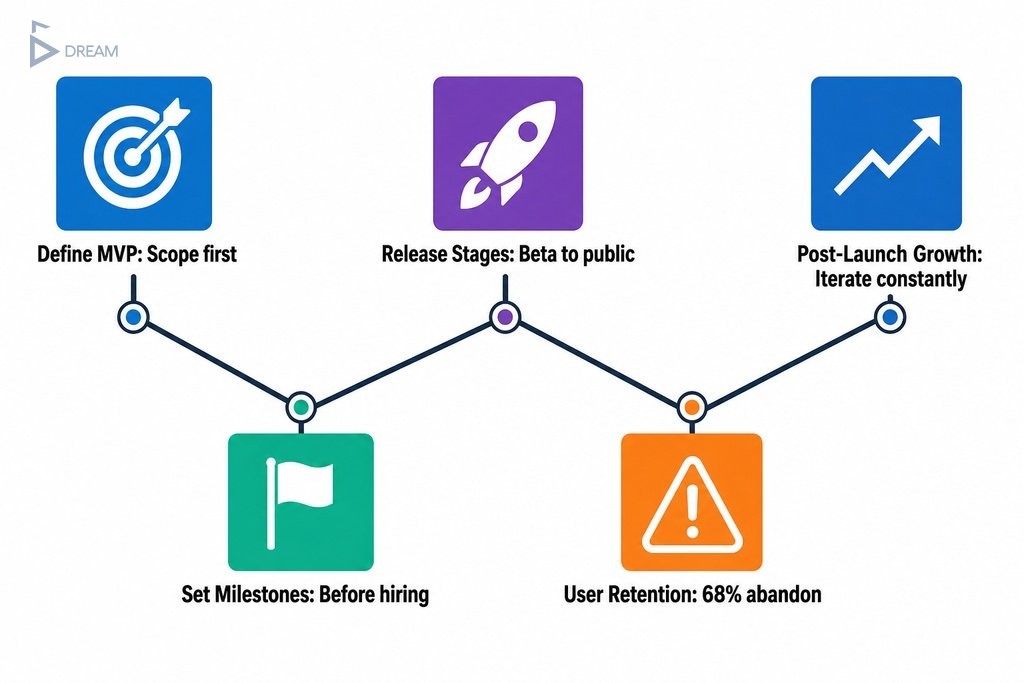
Understanding how to launch an mvp app starts with one honest question: what is the smallest version of this product that delivers real value to your core user? Everything else is a phase-two feature. Releasing a focused MVP lets you validate your core assumptions with actual users before investing in complexity, shortening the feedback loop and reducing financial risk considerably.
The practical exercise is straightforward: list every feature you imagine for the product, then sort each one into two groups — essential to the first release, or valuable later. Features in the second group belong on your roadmap, not your launch build. This scoping discipline ensures that only the features serving your immediate goal make it into the first sprint.
Setting Realistic Milestones Before You Hire Anyone
Before engaging any technical partner, map out rough phases and timelines yourself. You do not need to know how long each development task takes. You do need to know what the product should be capable of at each milestone and what decisions must be made before work begins. This preparation changes the dynamic with every agency or freelancer you speak to — you are no longer asking them to define the project for you, but evaluating whether their approach aligns with a vision you already own.
Founders who arrive at early conversations with documented goals, a defined user, and a scoped first phase consistently receive more accurate proposals and find better-fit partners. It is the difference between being guided through someone else’s process and choosing a process that genuinely serves your goals.
Building a Post-Launch App Roadmap That Scales
Launch day is a beginning, not a finish line. The apps that grow are the ones backed by a post-launch roadmap designed before a single line of code was written. That means planning for iterative cycles from day one: a first release, a period of listening to real users, a second release informed by what you learned, and so on. That rhythm is what separates products that gain momentum from those that stagnate after the initial push.
A scalable roadmap is structured around three inputs: user feedback from early adopters, performance data such as engagement and retention patterns, and evolving business priorities as your market position shifts. Each release cycle should be short enough to respond to what you are learning but substantial enough to deliver meaningful improvement. Phased feature rollouts let you test assumptions without committing to large builds and keep your development partner focused on what matters most right now.
According to Fortune Business Insights, the global mobile application market is projected to grow from $330.02 billion in 2026 to over $1,017 billion by 2034. Founders who enter this market today with a scalable post-launch plan are positioning themselves to capture a meaningful share of that growth, and Vancouver’s expanding tech sector puts local entrepreneurs in a strong position to compete.

App Growth Planning Basics Every Founder Should Know
Before committing to a development agreement, every non-technical founder should understand three foundational concepts that shape both the build and what comes after it.
Release Stages
Most apps move through at least three stages: a private beta with a small group of trusted users, a soft launch to a limited market, and a full public release. Each stage generates information that shapes the next. Skipping straight to a full release removes the safety net that early testing provides.
| Stage | Audience | Primary Purpose | Key Output |
|---|---|---|---|
| Private Beta | Small group of trusted users | Catch critical issues before wider exposure | Bug reports, early usability feedback |
| Soft Launch | Limited market or region | Test core assumptions with real users at low risk | Retention data, onboarding insights |
| Full Public Release | General audience | Scale acquisition and validate growth model | Broad engagement and monetization signals |
User Retention
The data here is sobering: research suggests 68% of app users abandon an app after just one use, and 22% abandon after three uses. Even a well-built product needs a deliberate onboarding strategy and early retention loops from the very beginning. Understanding how to measure app success after launch goes well beyond download counts. Engagement rates, session length, retention at day seven and day thirty, and the ratio of active to installed users are the signals that reveal whether your product is genuinely working.
Realistic Timelines for Vancouver Founders
In the Canadian market, a well-scoped MVP from a structured development team typically takes several months from discovery to launch. The exact timeline varies with feature complexity and how clearly the product is defined before development begins. Founders who plan for that reality from the start avoid the pressure that leads to poor decisions and rushed releases. An experienced app development company will walk you through what that timeline looks like for your specific scope, but entering that conversation with baseline knowledge makes the entire process smoother.
How to Grow an App After Launch Without Losing Momentum
Understanding how to improve an app after launch is one of the most underrated parts of the planning process. Growth rarely comes from a single large feature release. It comes from consistent, user-informed iteration: fixing friction in the onboarding flow, responding to the features users request most, improving performance on the devices your audience actually uses, and tightening the experience around the moments that matter most to your core user.
Feedback loops are essential. Whether through in-app surveys, direct user interviews, or monitoring support tickets for patterns, the goal is to stay close to your users’ experience and build a release calendar around what you learn. Apps that ship and go quiet lose users to products that visibly improve over time. Founders who sustain momentum treat their launch as the opening of a conversation with their users, not the conclusion of a build.
Planning your app monetization strategy for founders early also shapes how the product is built. Whether you plan to use subscriptions, in-app purchases, or a freemium model, that structure needs to be reflected in the product architecture from the start. Retrofitting a business model after launch is far more expensive and disruptive than designing around it from day one.

How to Choose the Right Vancouver App Development Partner
Not all development partners are built the same, and the stakes of getting this decision wrong are high. For non-technical founders in Vancouver, the right partner communicates clearly, structures delivery in a way that keeps you informed and in control, and maintains accountability after launch. An agency that goes quiet after shipping your product is a vendor, not a partner, and that distinction matters when your product needs to evolve with your users.
Before signing anything, ask every prospective partner how they handle scope changes mid-project, what their post-launch process looks like, how they structure client communication during development, whether they can share examples from similar industries, and whether they have references from founders without a technical background. Vague timelines, resistance to documenting milestones, and reluctance to discuss what happens after launch are all warning signs that reveal how a partnership will actually function when things get complicated.
| Area to Evaluate | Question to Ask | Red Flag Response |
|---|---|---|
| Scope management | How do you handle scope changes mid-project? | No documented change process or vague verbal assurances |
| Post-launch support | What does your post-launch process look like? | No defined process; support ends at delivery |
| Client communication | How do you structure updates during development? | Infrequent check-ins with no milestone documentation |
| Relevant experience | Can you share examples from similar industries? | Reluctance to provide case studies or references |
| Non-technical founder fit | Do you have references from non-technical founders? | Only technical stakeholder references available |
When to Bring in Outside Help and What to Prepare First
The right time to engage a development partner is after you have defined your core user, scoped your MVP, and mapped out at least a rough milestone structure. Arriving with a documented vision puts you in a position of clarity rather than dependency and protects you from partners who fill the vacuum of an undefined project with their own assumptions.
Before committing to any development agreement, have the following ready: a written description of your app’s core purpose and target user, a scoped list of MVP features distinct from future-phase features, a realistic budget range based on the scope you have defined, a set of measurable launch goals rather than just feature goals, and a clear expectation for post-launch support and iteration cycles.
At Twelfth Dream, we work with founders at exactly this stage. Based in Vancouver, our structured Agile process from discovery through deployment and ongoing support is designed to give non-technical entrepreneurs full visibility without requiring them to manage the technical details themselves. Whether you are building a mobile app for a specialised professional audience or a platform that fills a gap no existing product addresses, we bring the dedicated in-house team, the delivery discipline, and the long-term partnership that your vision deserves. If you are ready to move from idea to execution, we would love to hear what you are building.
Frequently Asked Questions Related to App Launch and Growth Planning
What is the most important step before launching an app?
Defining your core user and scoping your MVP are the most important steps before launch. Without a clear picture of who the app serves and what the first release must accomplish, development decisions lack direction and scope creep becomes difficult to control.
How long does it typically take to launch an MVP app in Vancouver?
A well-scoped MVP from a structured development team in the Canadian market typically takes several months from discovery to launch. The exact timeline depends on feature complexity and how clearly the product is defined before development begins.
What metrics should I track after my app launches?
Focus on engagement rates, session length, day-seven and day-thirty retention, and the ratio of active to installed users. Download counts alone do not reveal whether your product is genuinely working for the people using it.
Why do so many apps lose users quickly after launch?
Most users abandon apps due to a weak onboarding experience or a product that does not immediately deliver value. Research suggests around 68% of users abandon an app after just one use, which is why deliberate onboarding and early retention loops should be planned before launch, not added later.
When should I plan my app monetization strategy?
Plan your monetization model before development begins. Whether you choose subscriptions, in-app purchases, or a freemium structure, that decision shapes your product architecture, and retrofitting a business model after launch is significantly more costly than building around it from day one.
How do I choose the right app development partner in Vancouver?
Look for a partner who communicates clearly, documents milestones, and has an explicit post-launch process. Ask for references from non-technical founders and examples from similar industries. Vague timelines or reluctance to discuss post-launch support are reliable warning signs.