
Key Takeaways
App development timeline planning starts before any code is written and directly determines whether your launch lands on time or drains your budget.
- Nearly 45% of software project delays come from unclear requirements and scope changes, not technical problems, making early planning the most important risk to control.
- A structured discovery phase produces a tight, well defined scope that protects your launch date by ensuring only what users genuinely need is built first.
- Design changes made after development begins can extend timelines by 25 to 40%, so investing in prototyping and usability testing early saves significant time and cost later.
- Development milestone planning breaks your project into reviewable stages so problems are caught while they are still small and approvals keep the build moving forward.
- Third party integrations, platform choice, Canadian privacy regulations, and slow client feedback are among the most overlooked factors that shift delivery dates.
When a business owner decides to commission a custom app, the first question is almost always: how long will this take? It is the right question, but the honest answer depends almost entirely on decisions made before any code is written. App development timeline planning is the process of aligning scope, team structure, platform choices, and delivery milestones into a realistic schedule the entire project can be held to. Without it, even the most capable development team is navigating without a map.
For scaling businesses in Vancouver and across British Columbia, a poorly planned timeline does not just delay a launch. It drains budget, frustrates internal teams, and pushes your competitive advantage further out of reach. This article walks through how planning decisions compound across every phase of a build, which variables genuinely affect your schedule, and what to look for in a development partner who will deliver on their promises.
Table of Contents
Why Timeline Planning Matters Before a Line of Code Is Written
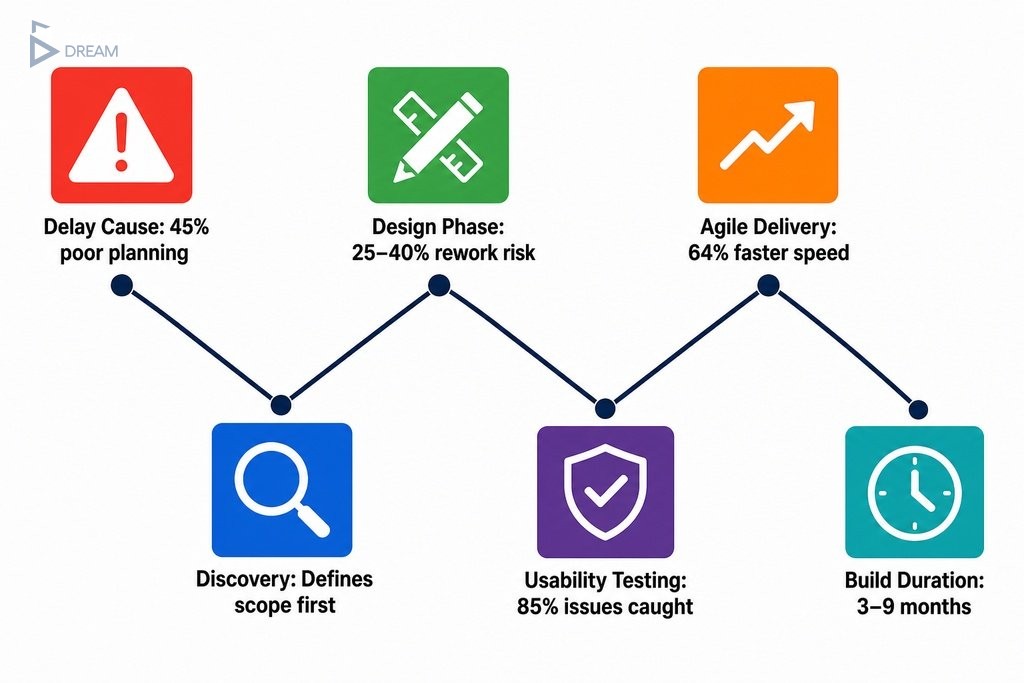
The most expensive problems in software projects are rarely caused by technical complexity. According to the Project Management Institute (PMI), nearly 45% of software project delays stem from requirement misunderstandings or scope changes, not technical failures. That means the majority of blown timelines trace back to conversations that either did not happen or did not go deep enough during the planning stage.
For a business owner who needs a reliable delivery date, this is the single most important risk to manage. Early planning creates a ripple effect: the features you agree to build in week one shape the design work in week four, which shapes the development effort in week eight, which determines whether you launch on time or renegotiate the schedule entirely. Rushing past planning to get to “the real work” is one of the most consistent patterns behind overruns.
The Key Phases of an App Project and What Happens Inside Each One
Most mobile apps take between three and nine months to develop, with complexity and scope being the primary drivers. Understanding what actually happens inside each phase helps business owners set expectations grounded in reality, not optimism. Each stage produces something concrete, feeds directly into the next, and carries its own risk if skipped or compressed.
Discovery and Scoping: Where Timeline Accuracy Begins
Discovery is the phase where the project takes its real shape. A development team works with you to identify which features are essential to solving the core problem and which belong on a future roadmap.
This distinction matters more than most owners realise. When a project enters development with a tight, well-defined scope, timeline estimates become far more accurate. When it enters with a wishlist, scope creep becomes almost inevitable, and every addition mid-build pushes the delivery date further out. The goal of discovery is not to limit your ambition. It is to protect your launch date by building only what your users actually need first.
Design and Prototyping: Decisions That Save Development Time
Design is where user experience decisions get resolved before they become expensive to change. Research from Adobe found that design changes made after development begins can extend timelines by 25 to 40% due to rework across screens and logic.
A clickable prototype tested with real users before development starts surfaces the majority of usability issues at a stage when fixes cost hours, not weeks. According to the Nielsen Norman Group, early usability testing identifies 85% of major usability issues before development begins. Investing in this phase is not a delay. It is one of the most effective ways to protect the rest of your schedule.
| Phase | Primary Output | Risk If Skipped or Compressed |
|---|---|---|
| Discovery and Scoping | Defined feature scope and realistic estimate | Scope creep, inaccurate timelines, mid-build rework |
| Design and Prototyping | Clickable prototype, resolved UX decisions | 25 to 40% timeline extension from post-development design changes |
| Development | Working feature set and integrated modules | Compounded delays from unresolved upstream decisions |
| Testing and QA | Verified, stable build ready for release | Post-launch defects, compliance gaps, failed store submissions |
The Biggest App Delivery Factors Vancouver Businesses Overlook
What affects app development time is rarely just the size of the feature list. Several delivery factors that business owners rarely anticipate can have a measurable impact on your schedule. Understanding these variables before you engage a development partner gives you a much clearer picture of your own situation.
Third-party integrations introduce dependencies your team cannot fully control. Connecting your app to payment processors, CRMs, logistics APIs, or government data systems can introduce unexpected delays if those external systems are undocumented or slow to respond.
Canadian regulatory requirements add compliance steps that take time to do properly. Apps handling personal data under British Columbia’s Personal Information Protection Act (PIPA) or federal PIPEDA, or operating in regulated industries, must account for this work in the initial plan, not as an afterthought.
Platform choice directly affects build time. Developing natively for both iOS and Android requires more effort than using a cross-platform framework, though the right choice depends on your users and performance requirements.
Client feedback turnaround is often underestimated. Development teams move fastest when approvals come back promptly at each milestone rather than sitting in an inbox for days.
| Delivery Factor | Timeline Impact | How to Manage It |
|---|---|---|
| Third-party integrations | Medium to high, depending on API documentation and responsiveness | Identify all integrations during discovery; build in buffer time |
| Canadian regulatory compliance (PIPA, PIPEDA) | Medium, adding design, documentation, and testing steps | Schedule compliance work from the start, not as an afterthought |
| Platform choice (native vs. cross-platform) | Medium to high; native iOS and Android requires more effort | Match platform to user needs and performance requirements |
| Client feedback turnaround | Low to high; slow approvals stall development momentum | Assign a decision-maker and agree on review turnaround windows |

How Milestone Planning Keeps a Project on Track
A timeline without structured checkpoints is really just an optimistic estimate. Milestone planning breaks a project into reviewable segments so you can see progress, confirm direction, and catch problems while they are still small. Each milestone produces something tangible: a completed design stage, a working feature set, or a tested module ready for integration.
This structure creates natural moments to pause, assess, and adjust without derailing the full schedule. Twelfth Dream’s adaptive release process is built around exactly this principle. Clients receive visibility at each stage of the build, which means informed decisions can be made before problems compound.
The State of Agile Report published by Digital.ai found that 64% of firms adopting Agile methodology reported a positive impact on delivery speed, with sprint planning and cross-functional teams identified as key contributors. When a client understands how agile development works for business apps, they become an active partner in protecting the timeline rather than a passive recipient of updates. That collaboration is one of the clearest separators between projects that land on time and those that drift.

What to Ask Your Development Partner Before the Project Starts
Not every development firm approaches planning the same way. The difference between a reliable partner and one that quotes low and adjusts late often becomes clear only after the project is already underway. Before committing to any engagement, ask these questions directly:
- How are initial timeline estimates produced, and what assumptions are they based on?
- What is the formal process when a scope change is requested mid-project?
- How are delays communicated, and who is responsible for raising a flag early?
- What does the milestone review process look like, and how much input does the client have at each stage?
- Is contingency time or budget built into the initial plan, and how is it managed?
No timeline is fully immune to change. Requirements evolve, external dependencies shift, and user feedback sometimes redirects priorities. The goal is not to find a partner who promises nothing will change. It is to find one with a clear, honest process for managing change when it does. A custom app planning checklist that covers these questions before a contract is signed is one of the most practical tools a business owner can use.
When Your Project Needs More Than a Quote
Some projects are complex enough that a reliable timeline simply cannot be produced from a short discovery call and a brief. When a build involves AI features, deep third-party integrations, compliance requirements, or team augmentation, committing to a fixed delivery date without a proper scoping engagement is a disservice to everyone involved.
Boston Consulting Group found that only 39% of projects meet their success criteria, and 45% of features built in software projects are never used. Both figures point to the same root cause: insufficient planning at the front end.
A formal discovery engagement resolves this. It is a structured, time-bound process that produces a detailed scope, a realistic timeline, and a cost estimate that can actually be held to. For business owners dealing with genuinely complex needs, skipping this step to get a faster quote is a false economy. The investment in a thorough discovery phase is what makes every subsequent phase dependable.
If your business in Vancouver, whether you are based in Yaletown, Mount Pleasant, or anywhere across the Lower Mainland, is ready to stop working around systems that no longer fit and start building something that works exactly the way you do, Twelfth Dream is ready to have that conversation. Reach out to the team and start with a planning discussion that respects both your ambition and your timeline.
Frequently Asked Questions About App Development Timeline Planning
How long does it typically take to develop a custom mobile app?
Most custom mobile apps take between three and nine months to develop. The range depends on the scope of features, platform choices, third-party integrations, and how promptly decisions are made during the build. A well-scoped project with active client involvement tends to land closer to the shorter end of that range.
What is the most common cause of app project delays?
Scope changes and requirement misunderstandings cause the majority of delays, not technical problems. According to the Project Management Institute, nearly 45% of software delays trace back to insufficient early planning. Investing in a thorough discovery phase before development begins is the most effective way to prevent this.
Why does the discovery phase matter for timeline accuracy?
Discovery defines exactly what will be built before any development begins. A clearly scoped project allows the team to produce accurate time and cost estimates. Without it, vague requirements lead to mid-project changes that extend the schedule and increase costs significantly.
How do Canadian privacy regulations affect an app development timeline?
Apps handling personal data in British Columbia must comply with PIPA, and federally regulated apps fall under PIPEDA. Meeting these requirements adds design, documentation, and testing steps that need to be scheduled from the start. Addressing compliance late in a project is one of the more disruptive causes of timeline overruns.
What is milestone planning and why does it matter?
Milestone planning divides a project into structured, reviewable stages, each producing a tangible deliverable such as a completed design or a tested feature set. It gives both the client and the development team clear checkpoints to assess progress, make decisions, and catch issues before they compound into larger delays.
Should I choose native app development or a cross-platform framework?
Cross-platform frameworks generally reduce development time and cost when targeting both iOS and Android. Native development offers greater performance and platform-specific capabilities but requires more time and budget. The right choice depends on your users’ needs, performance requirements, and long-term product roadmap.