Key Takeaways
Treating monetization as an afterthought is the most damaging mistake founders make; building your revenue model into the product from day one is what separates apps that scale from apps that stall.
- Plan your revenue model before a single line of code is written. Monetization assumptions shape feature priorities, onboarding design, and the data you collect from the start, and they are expensive to undo once the product is built.
- Avoid charging users too early. Research shows that 64% of consumers are more likely to use a paid app when they can try it first. Place your payment prompt at the moment a user has genuinely experienced the core value of your product.
- Match your revenue model to your users’ habits rather than copying competitors. Only 4% of apps monetise through paid downloads; most revenue now comes from post-install models, so defaulting to upfront pricing works against strong consumer expectations.
- Define your free and paid feature split before launch based on user goals. Features that build habit or reduce the perceived risk of upgrading belong in the free tier; features that deliver the outcome users ultimately want belong in the paid tier.
- Build in the right analytics from day one. Tracking meaningful signals such as average revenue per user, churn rate, and session length helps you distinguish between a pricing problem, a feature problem, and a UX problem so you can make precise improvements without guessing.
You have the idea, the domain expertise, and the drive to build something genuinely useful. But even the most well-conceived apps fail to generate revenue, not because the product is flawed, but because monetization was treated as an afterthought. For non-technical founders in particular, common app monetization mistakes often go unnoticed until user numbers are climbing and revenue is not. Getting these decisions right before a single line of code is written is one of the most powerful moves you can make as a founder, whether you are based in Vancouver, operating across British Columbia, or building for a broader Canadian market.
This article walks through the revenue-killing errors that surface most often during planning, launch, and growth, and explains how to sidestep them with a clearer, more deliberate approach to your app’s business model. Whether you are building your first mobile product or scaling an existing platform, these patterns directly separate apps that sustain themselves from apps that quietly stall.
Table of Contents
Why Monetization Strategy Fails Before a Single User Signs Up
Most founders treat revenue as a post-launch problem. The logic feels reasonable at first: build the product, find the users, then figure out how to charge. In practice, this sequence creates an enormous amount of avoidable pain. The most damaging mistakes are not made during scaling or after launch; they are made in the planning stage, when assumptions about user behaviour go untested and revenue logic is left undefined. By the time real users arrive, those assumptions have already been baked into the product in ways that are expensive to undo.
For non-technical founders, this is one of the highest-leverage decisions in the entire product journey. Choosing the right monetization approach early shapes feature priorities, onboarding design, pricing psychology, and the data you need to collect from day one. A structured development partner who brings a business analyst into the process before design begins can help you stress-test your revenue assumptions against real market conditions. The goal of an app monetization strategy for founders is not just to pick a revenue model; it is to validate that model against your specific users before it becomes load-bearing infrastructure.

Choosing the Wrong Revenue Model for Your App
Different apps attract users with entirely different payment expectations. A productivity tool used daily carries very different monetization potential than a niche utility opened once a month. Yet many founders default to whatever model is most visible in their category, copying subscription structures from apps with entirely different user relationships, or engineering elaborate freemium tiers without understanding what their users actually value.
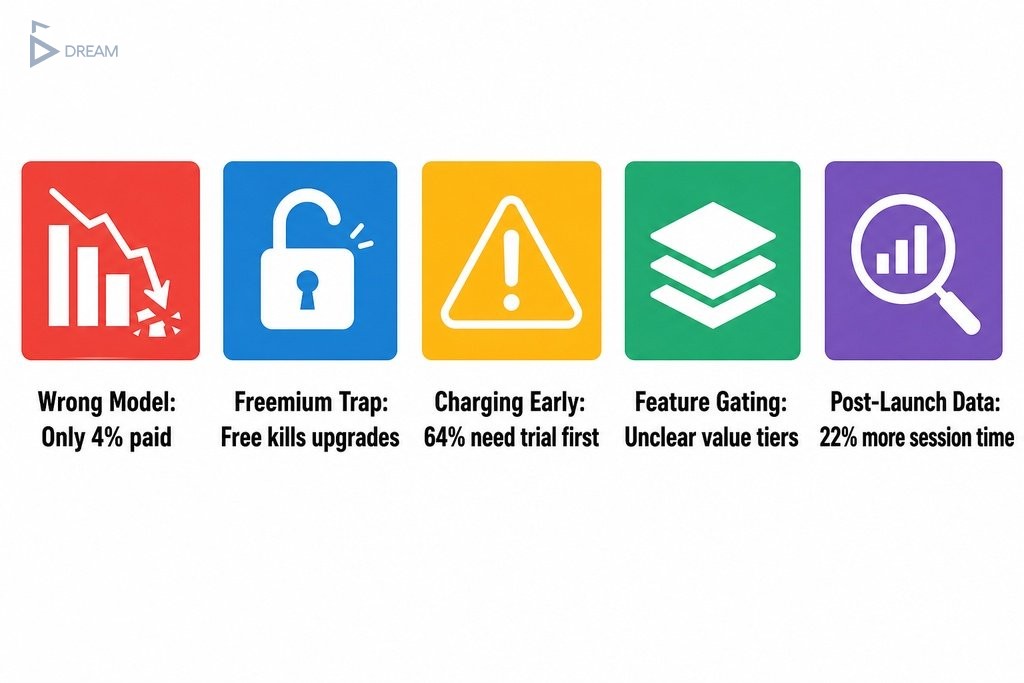
According to Statista and 42matters, as of September 2025, only 4% of apps were monetised as paid downloads, while 25% generated revenue through in-app advertising. This distribution reflects a market that has moved decisively toward post-install revenue models, and founders who still default to upfront pricing are working against a strong consumer norm. Choosing the wrong revenue model is a mistake that compounds over time: the longer a misaligned model runs, the harder it becomes to shift user expectations.
Matching your revenue approach to your users’ habits requires genuine curiosity about how they think about value and payment. The question of how to choose the right app business model is covered in depth in its own dedicated article, but the foundational principle is simple: the right model is the one that aligns with the moment your users feel the product has earned their money, not the moment you need revenue.
When Freemium Becomes a Trap
Freemium works well when the free tier creates genuine desire for the paid tier. It becomes a trap when the free experience is generous enough to satisfy most users indefinitely. Offering too much for free can permanently condition your user base to expect full access at no cost, making any future monetization attempt feel like a penalty rather than a natural progression.
The solution is not to make the free tier deliberately worse. It is to define, before launch, which features demonstrate enough value to justify payment and which serve as the on-ramp to that moment. Founders who limit their free offering to essential features and resist padding it out under pressure to impress early users protect their ability to monetize later.
Subscription vs. One-Time Purchase: Which Is Right for Your App?
The choice between subscription and one-time purchase is not just a pricing question; it is a statement about the ongoing value your app delivers. Subscriptions are most defensible when the product evolves regularly, delivers recurring outcomes, or integrates deeply into a workflow. One-time purchases work better for tools with a defined use case that does not require continuous development.
One data point worth noting for subscription-focused founders: according to Mobisoft Infotech app monetization research, annual subscribers churn at 60 to 70% lower rates than monthly subscribers. That has significant implications for how you structure your billing options from launch.
| Factor | Subscription | One-Time Purchase |
|---|---|---|
| Best suited for | Apps that evolve regularly or integrate into ongoing workflows | Tools with a defined, stable use case |
| Revenue predictability | High — recurring income stream | Lower — dependent on new sales |
| Churn risk | Monthly billing carries higher churn; annual billing reduces churn significantly | No ongoing churn, but no recurring revenue either |
| User expectation | Expects continuous updates and improvements | Expects a complete, stable product at time of purchase |
| Scalability | High — grows with user base | Limited — revenue plateaus without new users |
The Risk of Charging Users Too Early
One of the most common app monetization mistakes is pushing users toward payment before they have experienced genuine value. Users who encounter a paywall or aggressive upgrade prompt before they understand what the product does for them will leave, and they rarely come back. The friction is not the price itself; it is the absence of a compelling reason to pay it.
Research from Forrester found that 64% of consumers are more likely to use a paid app when they can try it first through a trial or freemium offering. That reflects a user psychology that demands proof before commitment, especially for unfamiliar products from brands without established trust.
Avoiding this trap means designing a trust-building path from first open to first payment. Identify the moment in your onboarding flow where a user has experienced the core value of your app, and place your monetization trigger there rather than at an arbitrary time or session count. Research from Braze found that aggressive pop-ups during onboarding cause a 27% drop in session duration, which compresses the window you have to build the trust that converts free users into paying customers.

How Poor Feature Decisions Create Pricing Problems
Bundling too many features into paid tiers, or gating the wrong ones entirely, sends users away before they understand what the product is worth. This is one of the most consequential app pricing mistakes to avoid, and it tends to originate in development rather than in pricing strategy. When feature decisions are made based on technical convenience or scope creep rather than user goals, the resulting product has no clear value hierarchy. Users cannot tell what they are paying for, and founders cannot coherently explain why the paid tier costs what it does.
Bloated apps with unclear feature structures make pricing almost impossible to defend. When everything is included in the paid tier, nothing stands out as worth paying for. Building only what is genuinely necessary at each stage, a principle Twelfth Dream applies throughout its structured delivery process, directly protects your monetization clarity. A leaner product with a well-defined free and paid split is easier to price, easier to sell, and easier to improve based on real user feedback.
Which Features Should Stay Free and Which Should Be Paid?
A practical way to decide what belongs in each tier is to ask: what does a user need to experience in order to understand and desire the full product? Features that demonstrate core value, build habit, or reduce the perceived risk of paying belong in the free tier. Features that represent the outcome the user is ultimately trying to achieve, or that meaningfully improve the experience beyond the baseline, belong in the paid tier.
This framework is grounded in user goals rather than development cost, which matters because users do not pay based on how long something took to build. They pay based on how much it changes their situation.
| Feature Characteristic | Recommended Tier | Rationale |
|---|---|---|
| Demonstrates core product value | Free | Users must experience value before they will pay for it |
| Builds daily or weekly habit | Free | Habit formation increases willingness to pay over time |
| Reduces perceived risk of upgrading | Free | Lowers the barrier to the first payment decision |
| Delivers the outcome the user ultimately wants | Paid | The end goal is the strongest driver of upgrade intent |
| Meaningfully improves experience beyond the baseline | Paid | Clear quality gap justifies the cost of upgrading |
| Built primarily for technical convenience or scope | Reassess | Features not tied to user goals weaken value clarity in both tiers |
Monetization Problems That Surface After Launch
Some monetization problems only become visible once real users are inside the product. Drop-off points, unexpected churn, and quiet resistance to upgrade prompts all signal a misaligned model. These are not signs that the product is broken; they are data. The challenge for founders without a technical background is knowing how to read these signals and distinguish between a pricing problem, a feature problem, and a UX problem.
Research from UXCam found that optimising screens with the highest exit rates led to a 22% increase in session time, which suggests that monetization problems after launch are often rooted in UX friction rather than the price point itself. Making targeted adjustments based on early signals is far less costly than rebuilding a pricing structure from scratch six months in. This requires that the right analytics are built into the product from the beginning, tracking meaningful KPIs like average revenue per user, churn rate, and session length rather than surface metrics like download counts. Founders who have these signals available can make precise, confident changes rather than guessing at what is undermining their revenue.

How Vancouver App Founders Can Balance Free and Paid Features
The balance between free and paid app features is rarely obvious upfront and should be treated as an evolving decision rather than a fixed structural choice. Founders who lock in their feature split before seeing real usage data are committing to assumptions that have not yet been tested. What feels like an obvious paid feature during planning may turn out to be the one thing users need to experience the core value. What feels like a generous free offering may turn out to be so complete that no one ever upgrades.
A structured, step-by-step release process, where each phase is reviewed before the next begins, gives founders the room to refine their monetization based on actual user behaviour rather than assumptions. This is the practical value of Twelfth Dream’s adaptive delivery model: each release stage generates real data that informs the next. Rather than building the entire paid tier in isolation and hoping it converts, founders can adjust the free and paid split incrementally as evidence accumulates. This approach reduces the cost of being wrong early and accelerates the path to a monetization model that actually performs.
Building a Revenue Model You Can Adjust as You Grow
A monetization strategy that works at 500 users will likely need rethinking at 50,000. User segments change, competitive pressure shifts, and the features that once justified the paid tier may become table stakes. Founders who build with this evolution in mind avoid the costly overhauls that come from treating the initial model as permanent.
Before committing to any pricing structure, it is worth validating through user research, reviewing competitive benchmarks in your specific category, and confirming that the technical foundation supports the billing, analytics, and access-control logic your model requires. Long-term technical support matters more in monetization than most founders expect. An app that cannot be updated quickly in response to churn signals, pricing experiments, or new competitive dynamics is an app that cannot protect its revenue. Working with a development partner who remains engaged after launch, maintaining the product and implementing improvements as your revenue goals evolve, is one of the most practical safeguards against the drift that turns a promising model into a stalling one. If you are a Vancouver founder ready to build a revenue model that can grow with your ambitions, the team at Twelfth Dream is here to help you get it right from the start. Reach out and let us bring your idea to life, with a monetization plan built in from day one.
Frequently Asked Questions Related to App Monetization Mistakes
What is the most common app monetization mistake founders make?
The most common mistake is treating monetization as a post-launch decision rather than building it into the product from the start. By the time users arrive, pricing assumptions have already shaped features, onboarding, and data collection in ways that are costly to reverse.
When should an app start charging users?
An app should introduce payment only after a user has experienced genuine value. Placing a monetization trigger at the point where core value has been demonstrated, rather than at an arbitrary session count or time limit, significantly increases the likelihood of conversion.
Is freemium always a good monetization model for apps?
Freemium works well when the free tier generates real desire for the paid tier, but becomes counterproductive when the free experience fully satisfies most users. The key is defining which features belong in each tier before launch, based on user goals rather than development convenience.
How do you decide which features to put behind a paywall?
Features that deliver the outcome a user is ultimately trying to achieve, or that meaningfully improve the experience beyond the baseline, are strong candidates for the paid tier. Features that build habit or reduce the perceived risk of paying belong in the free tier.
What analytics should a monetizing app track from day one?
Track meaningful KPIs such as average revenue per user, churn rate, and session length rather than surface metrics like download counts. These signals help founders identify whether revenue problems stem from pricing, features, or UX friction.
Can a subscription model work for a Canadian app with a small initial user base?
Yes, subscriptions can work at any scale if the product delivers recurring value. For smaller user bases, offering an annual billing option from the start is worth considering, since annual subscribers tend to churn at significantly lower rates than monthly subscribers.